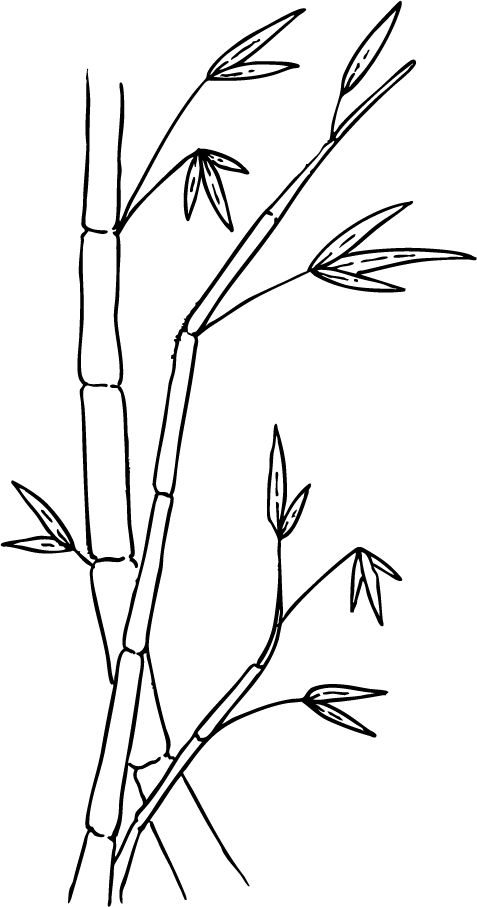
The Bamboo Syndrome
I planted a garden once, in the backyard of a rental house in Memphis, TN. I had big plans for my garden, though the unincorporated tangle of weeds and bamboo contained by a chain link fence behind the shed had different ideas. It took nearly two weeks of hacking and hauling off vegetation just to see the ground. Another week to cover the garden in cardboard and mulch, then construct a trio of raised wooden beds. Dirt and compost arrived by dump truck the following week. Nearly a full month of hard work passed before I planted anything. When I did, the sight was glorious. Tender shoots broke from rich black earth like hopeful fingers reaching skyward. I planted peas, potatoes, onions, melons, carrots, and garlic, alongside a host of herbs and spices. I couldn't wait to harvest the fruits of my labor. Visions of delicious sunset meals and shining rows of pickled vegetables in mason jars filled my every thought.
Each time a new shoot reared its emerald head, I celebrated. Time passed and my seedlings grew. I bolted to the garden every day after work, eager to check on its progress. Until one fateful evening in May, when I spied a stout shoot growing smack in the middle of my mulch walking path. The layer of cardboard and mulch beneath my garden should have been more than enough to prevent rogue weeds. I pulled the intruder up by the roots and threw it away. A fluke. The next afternoon, another shoot appeared by the onions. I plucked that one too, a little nervous. Before long, three or four shoots a day sprouted erratically from various points around my garden, determined, apparently, to claim my project as their own.
Invasion! I was at war. I hurriedly collected an arsenal of weed killers and chemical remedies. I spritzed and sprayed every alien tendril foolhardy enough to breach the perimeter of my garden wall, dual wielding neon bottles of Home Depot poison like an old west sheriff. I'd read Sun Tzu's Art of War at least a dozen times. Saving Private Ryan was my favorite movie. I completed two (almost three) semesters of Army ROTC. These weeds didn't know who they were dealing with.
My daily battle against the weeds crawled to a stalemate, more like a drawn-out siege than the brisk, victorious defense I'd imagined. For every shoot I cut down, dug up, or drowned with weed killer, three more took its place. I decided to tweak my strategy and founded an intelligence division. By that I mean I let the singular shoot in the corner by my tool table grow until it was clearly identifiable. With a bit of research, I planned to tailor my tactics to my opponent and deliver a deadly surgical strike. Imagine my surprise when the weed grew nearly to my waist in less than a week, and I discovered I'd been invaded not by an enemy, but by a friend.
There was a time when I considered bamboo my favorite plant. I enjoy how the dagger-like leaves bring shade; how in a dense patch of bamboo, the shiny stalks rub together and squeak, as if laughing. When I lived in the jungle for a summer, one of my favorite pastimes was to lie down in the bamboo grove by the river and watch those towers of green sway overhead in the breeze. It made me feel small and safe. As a perpetual maker of things, I prize bamboo for its straight, flexible, strong stalks, which are good for anything from curtain rods to walking sticks, long bows to ladders. There's a possibility inherent in bamboo, a future without bounds or borders, which is precisely the problem.
Bamboo doesn't know when to stop. It is a lead foot on a gas pedal, ravenous, blind, ambitious to the point of insanity. Some species of bamboo can grow three feet in a single day. You can literally watch it grow. Bamboo doesn't employ deep roots for stability like other plants. Instead, bamboo uses rhizomes to support itself — shallow, widespread tendrils that prioritize horizontal growth and propagating shoots over vertical depth. Roots typically have a single point at their tips from which they can grow. Bamboo rhizomes, on the other hand, are covered with entire zones dedicated to growth, enabling rapid simultaneous expansion in all directions. Left to its own devices, bamboo will choke out all other plant life, draining nutrients from the soil, stealing water for itself, and blocking out the light.
The beauty of a garden, and what separates it from, say, a commercial corn farm, is variety. A garden is as much about its population's health as it is about crop diversity, and the symbiotic benefits that relationship fosters. Potatoes are no more important than tomatoes, and the herbs can't claim superiority to the onions. The deep-diving roots of comfrey and daikon radish break up compacted soil and deliver nutrients to the surface. Aromatic herbs discourage predatory insects. Garlic planted near roses suppresses aphids and mold. Taller, fuller plants shelter smaller, weaker ones from damaging wind. But the instant any part of a garden considers itself more valuable than the whole, especially those branches prone to explosive growth, the entire endeavor is doomed.
Bamboo doesn't only devour gardens. I've seen it gobble up businesses too. I met a man at a networking event who'd recently resigned from a leadership position at a startup consulting firm. He worked directly for the firm’s founder and CEO. For anonymity's sake, let's call the man I met Aidan and his CEO, John. Time and again, John proved he was ready, willing, and able to sacrifice anything and anyone on the altar of his firm's growth. John poured his company's coffers almost exclusively into ad spend and aggressive sales tactics, neglecting such trivialities as employee health insurance, filing his taxes correctly, supplying his team with even basic technology, and paying his third-party vendors.
During his time with the firm, Aidan saw remarkable client growth, sometimes doubling month over month, with little attention given to the systems or processes meant to support that growth, much less the actual products being shipped to customers, most of which were laughably oversold. As long as the numbers were climbing, it didn't matter. Employees were so loaded down with work that it wasn't uncommon for people to walk off the job mid-shift in tears. Deliverables were hastily slapped together; it was all Aidan's coworkers and reports could do to just get something out the door by John's impossible deadlines — the ones he used to upsell prospects so he could point to growing numbers at the next investor meeting. Unsurprisingly, John’s clients felt tricked. They'd paid a lot of money for products that simply didn't work. They spent hours on calls with their project managers, red-faced and spitting. When angry clients (all of them, mostly) complained about the blatant lack of delivery, or even threatened to sue, John instructed Aidan to alter the agency's client contracts in the dead of night. By morning, John was proven correct, and otherwise released from responsibility. Morals be damned.
John’s startup looked excellent on paper. The exponential growth drew investors like moths to a flame. What the investors didn't know, and what ultimately buried the company, was how shallow and shoddy the foundation was, precisely for the sake of all that growth. The firm was a momentous castle built on sinking sand, and it crashed and burned within two years. Aidan barely escaped with his reputation and career intact. Though not thanks to John, who, during the firm’s last days, attempted to sell Aidan the dying business, including its overdrawn credit cards, fleeing customer base, and numerous lawsuits.
I never figured out how to get the bamboo out of my garden. Four to five shoots a day turned into ten or twelve. My seedlings started dying. None of my strategies worked. When I came back from a week-long summer vacation, my garden was gone. In its place stood a miniature forest of ramrod flagpoles, hip high, and so green they hurt to look at, verdant leaves swaying gently in the breeze.
It would be easy to turn the bamboo that conquered my garden into an enemy, the same way it would be to point at a growth-obsessed tech giant as an example of corporate villainy. Here's the thing: growth is not evil. Growth is blind. It's a powerful engine and an insightful metric, but when placed on a pedestal and given the keys to the kingdom, a company-wide devotion to rapid exponential growth will undermine and degrade all other functions and departments, the very ones that made growth possible in the first place. So what is a business to do? What is a garden to do?
The answer lies not in the bamboo itself, but in the structure of the system it supports. Bamboo's proper place is not running unchecked through the carrots and cabbage, free to strangle and claw its way to infinity. Rather, bamboo is best housed in a dedicated planter, ideally made of concrete or metal and raised out of the ground. This allows the bamboo to do its thing—provide shade, privacy, a nesting place for birds—without overtaking the rest of the garden. Like sharp stakes and deep roots, balance and boundaries are as important in the boardroom as they are in the backyard.